What if the primary obstacle to your firm's expansion isn't a lack of talent, but the manual friction embedded in your daily workflows? You likely recognize the strain when manual lead routing slows your sales cycle or when data from your SEO forms doesn't align with your CRM. It's difficult to maintain a clear view of project statuses when information is trapped in silos. These operational gaps don't just waste time; they actively erode your bottom line. Implementing professional business process automation services provides the structural integrity needed to bridge these gaps and replace manual patches with reliable systems.
This approach eliminates operational friction and establishes a transparent, data-driven foundation for sustainable growth. We'll explore how to create a unified system where data flows automatically to reduce overhead and accelerate lead response times. By moving from fragmented tasks to an integrated architecture, you gain the clarity required to lead your organization with confidence. This guide outlines the path toward a more efficient, scalable operation that allows your team to focus on their core mission rather than data entry.
Key Takeaways
- Recognize how manual data entry creates an invisible tax on your operations by slowing response times and fragmenting your client data.
- Learn why professional business process automation services are a strategic investment in structural integrity rather than a simple software purchase.
- Discover how to map your current workflows to identify high-frequency, low-complexity tasks that offer the most immediate return on investment.
- Evaluate the long-term advantages of owning your automated systems compared to the recurring costs and management overhead of outsourcing.
- Understand the diagnostic framework required to bridge the gap between your marketing efforts and your CRM for a unified data flow.
Table of Contents
- The Hidden Cost of Manual Operations: Why Firms Seek Automation Services
- Core Components of Professional Business Process Automation Services
- Automation vs. Outsourcing: Choosing the Right Scaling Strategy
- Auditing Your Workflow: A Framework for Automation Readiness
- Implementing Scalable Systems with Appixi’s Automation Expertise
The Hidden Cost of Manual Operations: Why Firms Seek Automation Services
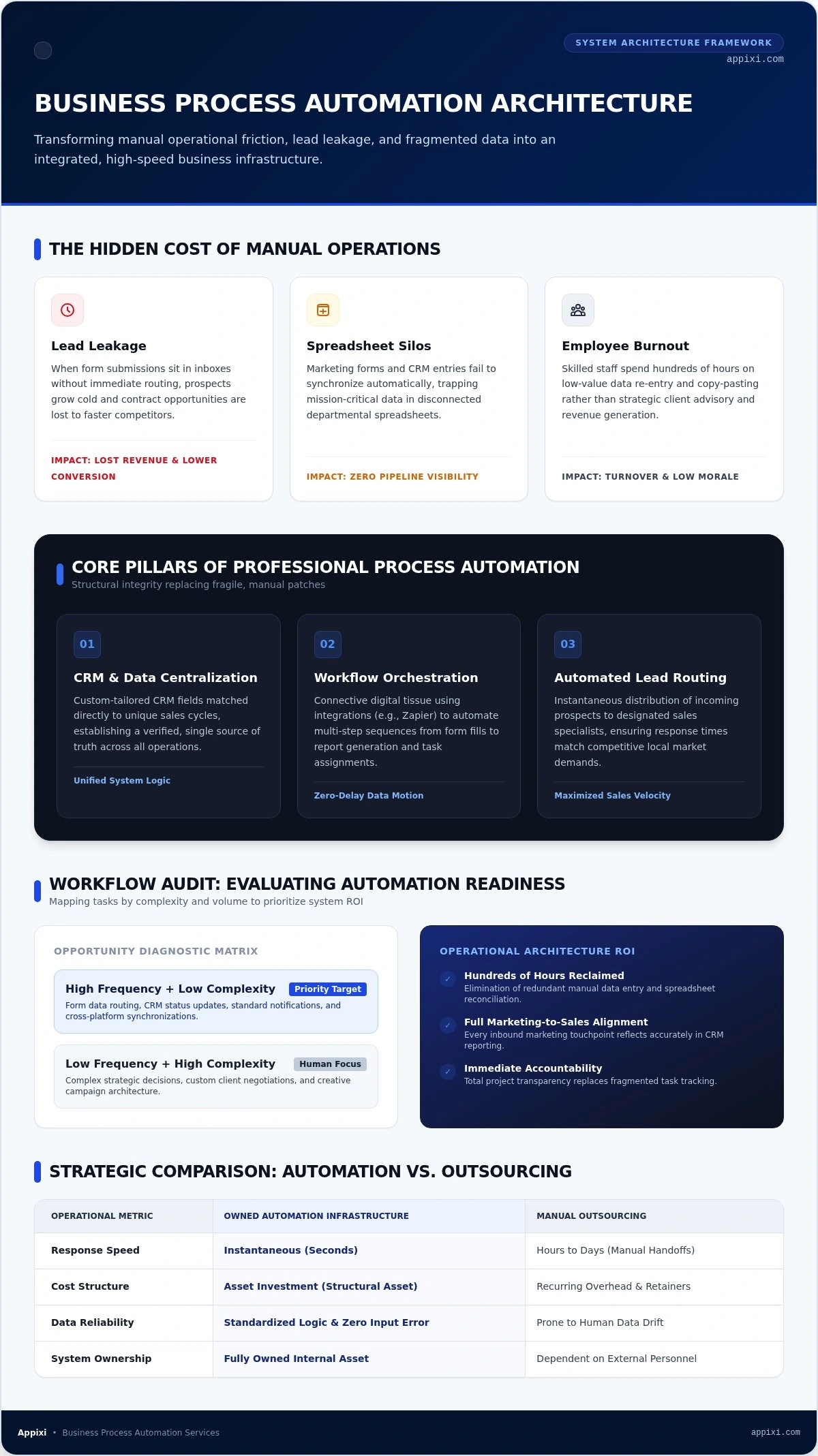
Every manual task your team performs acts as an invisible tax on your business's ability to scale. While individual data entry tasks might only take minutes, their cumulative impact creates significant operational friction. This friction slows down your response times and degrades the client experience. When systems remain disconnected, you face lead leakage. This happens when potential customers fall through the cracks because information didn't move between your marketing forms and your CRM fast enough. Professional business process automation services transform these reactive, manual patches into a proactive strategy. By implementing business process automation, you move from a state of constant catching up to a structured environment where data moves with precision. This shift is less about buying new software and more about designing a better architecture for your daily operations.
The Lead Leakage Problem in Local Georgia Markets
In competitive markets like Atlanta, the speed of your response often determines whether you win a contract. If a lead fills out a form on your website and it sits in an inbox for hours, you've likely already lost to a faster competitor. Automated tracking bridges the gap between your marketing spend and your actual sales results. It ensures that every dollar spent on marketing translates into a visible entry in your CRM without human intervention. Automated lead routing then places that prospect in front of the right salesperson immediately. This eliminates the delays that typically cause leads to go cold and ensures your sales team operates at peak efficiency.
Operational Friction and Employee Burnout
Repetitive tasks are a primary driver of staff turnover and burnout. When skilled employees spend their days on "busy work" like copying data between spreadsheets, they aren't performing the high-value work you hired them for. This lack of system visibility makes it difficult to hold teams accountable because nobody knows exactly where a project stands. Replacing these manual touchpoints with structured workflows provides immediate clarity. It allows your staff to focus on strategy and client relationships while the software handles the routine logistics. This shift improves morale and ensures that your internal business systems support your team rather than hindering them. Utilizing professional business process automation services allows you to reclaim hundreds of hours of lost productivity each year while creating a more stable environment for your workforce.
Core Components of Professional Business Process Automation Services
Professional business process automation services represent more than just a collection of software tools. They are the strategic architecture of your digital workflows. A well-designed system ensures that data doesn't just exist but moves purposefully between your marketing, sales, and fulfillment departments. By bridging operational gaps with custom software and AI-driven response systems, firms can ensure that no lead is left unaddressed. This structural approach replaces the chaos of manual hand-offs with a predictable, repeatable process that supports long-term stability. It works.
CRM and Business System Implementation
Relying on fragmented spreadsheets creates silos that hinder your growth. Transitioning to a centralized source of truth is a critical step in managing business operations efficiently. A professional implementation involves customizing CRM fields to match your specific business logic rather than forcing your team to adapt to a generic template. This level of precision ensures that every data point captured is relevant to your unique sales cycle. Clarity follows structure. If you're ready to move beyond basic tools, a Custom CRM implementation for small business provides the visibility needed to track performance accurately.
Automated Workflow Orchestration
Workflow orchestration is the connective tissue of your digital ecosystem. Tools like Zapier allow disparate applications to communicate, turning isolated tasks into a single, fluid motion. For example, when a prospect requests an SEO audit, the system can automatically generate the report, create a lead in the CRM, and schedule a sales follow-up task. This automation prevents the delays that often occur when humans are required to move data between platforms. Data normalization is essential here; it ensures that information from your website forms is formatted correctly before it reaches your sales team. Without this step, your CRM quickly becomes cluttered with inconsistent entries that are difficult to filter or analyze.
Effective automation requires a partner who understands the nuances of your specific industry. By choosing professional business process automation services, you're investing in the future viability of your entire organization. You can explore our methodical approach to system design to see how we build these foundations for our clients. By focusing on structural integrity, we ensure your automation grows alongside your firm without requiring constant manual intervention.
Automation vs. Outsourcing: Choosing the Right Scaling Strategy
Scaling a Georgia firm often forces a choice between hiring more help or building better systems. While outsourcing provides immediate relief, it creates a permanent line item on your balance sheet that grows alongside your revenue. By contrast, professional business process automation services transform your operational logic into a digital asset. This isn't just about saving time; it's about shifting from a labor-dependent model to a system-dependent one. Software doesn't require management, benefits, or office space. It executes tasks with a level of speed and precision that human processing simply cannot match. You aren't just buying help; you're building a foundation.
The Asset Ownership Advantage
Building an internal automation system directly increases your company's valuation. Investors and buyers look for structural integrity; they want to see that a business can function predictably without the founder's constant oversight. An organization that relies on documented, automated workflows is fundamentally more stable than one where knowledge resides solely in the heads of outsourced contractors. We've seen firms struggle with "vendor lock-in" where they lose access to their own data when a third-party relationship ends. To prevent this, Appixi ensures full client ownership of all systems and data. Our methodical design process prioritizes transparent documentation, ensuring you maintain control over your infrastructure. You own the code, the workflows, and the data that drives your growth.
When to Automate and When to Outsource
Not every task is ready for pure software execution. High-frequency, low-complexity tasks are the primary candidates for business process automation services. If a process follows a strict "if-then" logic, it should be automated. However, nuanced decisions involving emotional intelligence or complex ethical trade-offs still require human intervention. This is where the "human-in-the-loop" model excels. In this framework, AI handles the heavy lifting of data gathering and normalization, while your staff makes the final strategic call. This hybrid approach allows your team to perform high-value work without being bogged down by the logistics of information movement. It's about empowering your staff, not replacing them. By choosing automation over simple outsourcing, you're investing in a permanent solution that compounds in value over time.
Auditing Your Workflow: A Framework for Automation Readiness
Scaling requires more than just adding software; it requires a deep understanding of your current infrastructure. Before engaging with professional business process automation services, you must establish a clear baseline of your operations. This audit phase prevents the common mistake of automating a broken process, which only serves to accelerate inefficiency. By following a structured framework, you ensure that your systems are built on a foundation of logic rather than guesswork. Clarity is the precursor to efficiency.
Mapping the Invisible Workflow
The first step in your audit is documenting the "as-is" process. This involves tracking every manual touchpoint a piece of data hits from the moment it enters your ecosystem. During this mapping, you'll likely discover "shadow IT" or informal workarounds that your team has created to compensate for existing system gaps. These informal workarounds are often the biggest inhibitors to scaling because they lack documentation and consistency. Conducting stakeholder interviews is vital during this phase. Your staff on the front lines know where the operational friction exists better than any manual can describe. By mapping these invisible workflows, you identify the exact points where manual entry is causing delays or errors.
Prioritizing Automation Opportunities
Once the map is complete, you can prioritize tasks using a "Quick Win" matrix. Focus on high-frequency, low-complexity tasks that offer the most immediate relief to your team. Lead routing often yields the fastest ROI because it directly impacts your conversion rates and the speed of your sales cycle. However, as you automate these interactions, you must ensure your branding and messaging remain consistent. An automated reply that feels cold or disconnected from your brand identity can alienate prospects before a human ever speaks to them. Data integrity between your website and back-office is the final piece of the readiness puzzle. If the information captured by your forms doesn't match the fields in your CRM, the automation will fail to provide a "single source of truth."
To move forward, you need to define measurable KPIs for success, such as a 50% reduction in lead response time or a specific decrease in manual entry hours. A critical part of this readiness check is identifying where you are losing potential customers before they even reach your sales team. You can request a website conversion audit to find these lead gaps and prepare your firm for a full system integration. Professional business process automation services are most effective when they are applied to a business that has already identified its structural weaknesses and set clear goals for improvement.
Implementing Scalable Systems with Appixi’s Automation Expertise
Appixi approaches business process automation services with the mindset of a strategic architect rather than a simple software vendor. We utilize a rigorous Diagnostic and Prescription methodology to ensure that every technical implementation serves a documented business need. For firms in Alpharetta, Roswell, and Marietta, this means moving beyond generic software setups toward a custom-coded infrastructure that mirrors your specific business logic. Our commitment to professional transparency involves a clear project scope and consistent communication throughout the build process. This structured approach lowers the anxiety often associated with technical shifts by replacing ambiguity with methodical logic. You maintain full ownership of the resulting systems and all internal data.
A Holistic Approach to Digital Systems
A truly efficient digital ecosystem requires that your front-end presence and back-end operations function as a single, fluid unit. Automation shouldn't be an afterthought. It must be integrated directly with your Website Design and Development to ensure data flows without friction from the first click to the final sale. This integration allows your SEO strategy to feed leads directly into an automated CRM, effectively eliminating the manual entry gaps that hinder growth. For businesses offering technical or complex services, we often incorporate 2D/3D animation to explain these sophisticated workflows to stakeholders or clients. This creates a necessary bridge between technical execution and clear, authoritative communication. It makes the complex understandable and manageable.
Getting Started: From Audit to Implementation
The transition from a manual operation to a scalable system begins with the audit framework we previously established. We identify the specific lead gaps and data silos that are currently restricting your expansion. For local firms in Cumming GA, scheduling a consultation is the first step toward reclaiming your team's time and energy. Our process moves from initial diagnosis into a structured implementation phase where we build, document, and test every workflow to ensure long-term stability. Following the initial launch, we provide a support model that allows your systems to evolve as your firm expands. This continuity ensures that the structural integrity of your business process automation services remains intact even as your business requirements change. We take responsibility for the technical complexity so you can focus on your core mission.
Establishing Your Foundation for Scalable Growth
Transitioning from manual, reactive operations to a structured digital architecture is the most reliable path toward sustainable expansion. By replacing fragmented workflows with professional business process automation services, you convert recurring labor expenses into a permanent company asset. This approach ensures that your data flows with precision, allowing your team to focus on high-value strategy rather than routine data entry. We prioritize your empowerment by ensuring you maintain full ownership of all systems and data. Our project-based fees and local expertise in the Atlanta metro area provide the transparency needed to move forward without the fear of hidden costs or vendor lock-in.
The first step toward operational health is understanding where your current friction exists. Identify your automation gaps with a free Website Conversion Audit to begin building your firm's future today. Order and transparency are within reach; we're ready to help you build the systems that support your core mission for years to come.
Frequently Asked Questions
What are business process automation services?
Business process automation services involve the strategic design and implementation of digital workflows to replace manual, repetitive tasks. By integrating your marketing forms, CRM, and fulfillment systems, these services ensure that data moves accurately across your entire organization. This structural approach eliminates the operational friction that often hinders firms in the Atlanta metro area. It allows your staff to focus on high-value strategy while software handles the routine logistics of data entry and routing.
How much do automation services cost for a mid-sized business?
We utilize project-based fees with clear, documented scopes rather than open-ended billing cycles. The total investment for business process automation services depends on the complexity of your existing systems and the number of manual touchpoints requiring integration. We provide a transparent breakdown of costs during the diagnostic phase so you can evaluate the long-term ROI of building a scalable foundation. This model ensures you have a predictable budget for your operational improvements.
Can automation replace my existing employees?
Automation is designed to empower your team rather than replace them. By removing the "busy work" of manual data entry, your staff can dedicate their expertise to high-value tasks that drive revenue. For firms in Alpharetta and Roswell, this shift often leads to higher employee satisfaction and reduced burnout. Our goal is to create a system where your people manage the strategy while the software manages the routine movement of information.
Which business processes should I automate first?
You should prioritize high-frequency, low-complexity tasks that offer the fastest return on investment. Lead routing is often the best starting point because it directly impacts your response times and conversion rates. Syncing website forms with your CRM ensures that no prospect falls through the cracks due to manual delays. By addressing these lead gaps first, you create an immediate improvement in your sales cycle efficiency while preparing for more complex system integrations.
How long does it take to implement a custom automation workflow?
The timeline for implementation varies based on the scope of the diagnostic and prescription phase. A standard project begins with a comprehensive audit of your current "as-is" processes to identify friction points. Following this audit, we build, test, and document the new workflows to ensure long-term stability. While simple integrations may take a few weeks, more complex custom software solutions require a longer development cycle to ensure full structural integrity and data normalization.
Will I still own my data and systems if I use an automation agency?
Yes, you maintain full ownership of all systems, code, and data built during your project. Unlike some vendors who create "lock-in" through proprietary platforms, we prioritize client empowerment and transparent documentation. This means you have the freedom to manage or evolve your internal infrastructure as your firm grows. Our local team in Cumming GA ensures that your digital assets remain under your direct control at every stage of the implementation process.
What is the difference between RPA and BPA?
Robotic Process Automation (RPA) focuses on software bots mimicking specific human actions, like clicking buttons or copying text. Business Process Automation (BPA) is a more holistic approach that redesigns entire workflows for efficiency and structural integrity. While RPA handles isolated tasks, BPA integrates your marketing, sales, and fulfillment systems into a single, fluid ecosystem. For most growing Georgia firms, a BPA strategy provides the sustainable foundation needed for long-term scalability and visibility.
Do I need custom software or can I use off-the-shelf tools?
Many automation projects utilize a hybrid approach, connecting off-the-shelf tools like CRM platforms with custom-coded middleware. Tools like Zapier can often bridge simple gaps, but unique business logic frequently requires bespoke software solutions to ensure data integrity. We evaluate your specific operational needs to determine which combination of tools provides the most reliable result. Our focus is on building a system that matches your unique workflow rather than forcing you into a generic template.