A practical guide to auditing technical performance, user experience, and messaging so website teams can prioritize conversion fixes.
If your website receives steady traffic but your lead notifications remain silent, is the problem your marketing or the destination itself? It's frustrating to invest heavily in SEO and paid ads only to watch potential customers exit your service pages without taking action. You likely suspect that technical glitches or confusing messaging are draining your budget, but pinpointing the exact leak often feels like expensive guesswork. We understand the operational strain of managing a digital presence that feels disconnected from your bottom line.
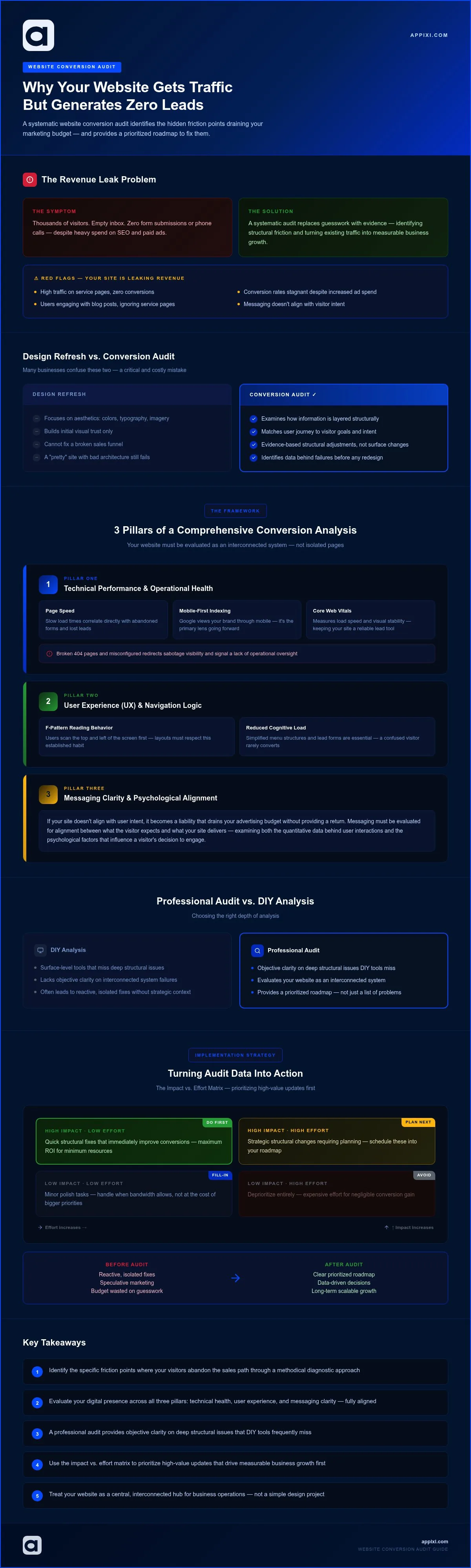
This guide demonstrates how a methodical website conversion audit identifies hidden friction points and turns a broad set of observations into a practical improvement plan. You'll learn how to replace ambiguity with structured logic by evaluating user intent and aligning it with your core messaging. We will preview a diagnostic framework that provides a prioritized list of high-impact fixes, moving your business away from reactive tasks and toward a clear roadmap for long-term improvement. By treating your site as an interconnected system rather than a collection of isolated pages, you can make better use of the traffic you already have.
Key Takeaways
- Identify the specific friction points where your visitors abandon the sales path through a methodical diagnostic approach.
- Evaluate your digital presence across three core pillars to ensure technical health, user experience, and messaging are fully aligned.
- Understand why a professional website conversion audit can provide the objective review needed to find structural issues that surface-level tools may miss.
- Learn how to use an impact-versus-effort matrix to prioritize high-value updates and define what should happen first.
- Transition from viewing your site as a simple design project to managing it as a central, interconnected part of your business operations.
Table of Contents
What is a Website Conversion Audit and Why Does Your Business Need One?
A website conversion audit is a systematic evaluation of your digital platform's ability to transform passive visitors into active leads. Rather than relying on gut feelings or aesthetic preferences, this process identifies specific friction points where potential customers lose interest or experience technical hurdles. It serves as a diagnostic roadmap for improvement, helping a team evaluate whether the website supports its business goals. By examining the available evidence behind user interactions, you can move from speculative marketing to a strategy grounded in observed behavior.
This methodical approach is a foundational element of conversion rate optimization, focusing on data-informed decisions rather than trend-based guesses. If your site doesn't align with user intent, it can drain your advertising budget without providing a useful return. An audit provides the visibility needed to understand why visitors may be leaving and which changes are worth testing.
The Difference Between a Design Refresh and a Conversion Audit
Many business owners confuse a visual update with a strategic overhaul. A design refresh focuses on aesthetics, such as updated color palettes or modern typography. While visual appeal can build initial trust, it cannot repair a broken sales path. If the underlying architecture is flawed, a visually polished website may still fail to generate useful enquiries. A professional audit prioritizes evidence-based structural adjustments over surface-level changes. It examines how information is layered and whether the user journey matches the visitor's goals. If you are considering a website redesign, you must first understand the evidence behind the current problems to avoid repeating them in a new layout.
Signs Your Site is Leaking Revenue
Identifying a revenue leak requires looking beyond total traffic numbers. If your analytics show thousands of visitors but your inbox remains empty, your site may have a structural disconnect. High traffic volume on service pages that results in zero form submissions or phone calls is a primary red flag. Stagnant conversion rates despite increased spending on SEO or paid advertising may suggest that friction lies within the user experience itself. You might also notice users spending significant time on informational articles while ignoring your primary service offerings. When these patterns emerge, a website conversion audit can help separate a traffic problem from a destination problem and define what to investigate next.
The Three Pillars of a Comprehensive Conversion Analysis
A high-performing website functions as an interconnected operational system. If you treat your pages as isolated assets, you miss the structural friction that prevents them from working together. A comprehensive website conversion audit examines the technical, behavioral, and messaging factors that influence a visitor's decision to engage. This methodical approach looks at the wider customer path rather than a single landing page in isolation.
Technical Performance and Operational Health
Slow load times add friction to shopping, enquiry, and lead-form paths. If your infrastructure is sluggish, some visitors may leave before the value proposition or primary action becomes available. Google uses the mobile version of a site for indexing, so mobile-first indexing and mobile task completion belong in the technical review. Broken 404 pages and misconfigured redirects also affect user experience and discoverability. Core Web Vitals provide standardized field measures for loading performance, responsiveness, and visual stability, but they should be reviewed alongside real customer tasks and business outcomes.
User Experience (UX) and Navigation Logic
Effective layouts help readers scan, understand, and act without unnecessary effort. Reduce cognitive load by simplifying menu structures, clarifying labels, and asking only for information a lead form genuinely needs. A detailed website conversion audit can reveal navigation and interaction problems that are worth testing. Consistent website maintenance helps keep those paths stable as the site changes. Accessibility is also part of website health because important content and actions should remain usable across different devices and access needs.
Messaging Alignment and Brand Authority
Your brand messaging must address the intent and questions of the audience you want to reach. In local service markets, verified reviews and other genuine trust evidence can help customers evaluate the next step. Review the clarity of primary and secondary calls to action so visitors can move forward without ambiguity. If your value proposition is buried under industry jargon, people may struggle to determine whether the offer fits. Every important page should have a clear job and a useful next action. You can explore Appixi's service overview to see how website, brand, marketing, automation, and customer-system work connect.
Professional Audit vs. DIY Analysis: Choosing the Right Depth
Determining the appropriate depth for a website conversion audit requires an honest assessment of your current business objectives. A surface-level review might fix a typo or a broken link, but it won't resolve a systemic decline in lead volume. Professional review becomes more useful when the path crosses analytics, content, forms, integrations, and several teams. Automated tools can provide a baseline, but their output still needs interpretation in the context of the business and its customers.
When a DIY Checklist is Sufficient
A DIY approach is a practical starting point if your site is in its infancy or if you're managing a small local operation with limited traffic. In these scenarios, your primary focus is often on basic accuracy and accessibility. You can use manual spot checks to identify broken links, outdated service descriptions, or incorrect phone numbers. Public speed tests offer a snapshot of load behavior and can expose obvious technical issues. These steps create a useful baseline, but they do not replace deeper analysis when several customer and operational systems are involved.
The Strategic Advantage of an Agency-Led Audit
The strategic advantage of an agency-led audit lies in connecting quantitative metrics with observed customer behavior and business context. A tool may show that a visitor left a page; a reviewer can investigate the likely causes through analytics, page structure, messaging, form behavior, and customer or sales feedback. This outside perspective can also expose assumptions that have become difficult for an internal team to see. A professional website conversion audit may lead to technical improvements, such as integrating custom business software or CRM systems to streamline lead management and operations.
For Georgia businesses serving markets such as Alpharetta and Roswell, the review should account for the actual service area, customer questions, and delivery model rather than adding local language for its own sake. An agency-led approach can connect evidence from SEO, paid media, social channels, and the website experience. This makes it easier to identify an operational gap, such as a disconnect between a campaign promise and the page or follow-up process that receives the lead.
Turning Audit Data into Action: A Prioritized Implementation Plan
An audit is only as valuable as the execution that follows. Once you complete a website conversion audit, you're often left with a long list of findings that can feel overwhelming. To maintain momentum, move from a broad list of observations to a structured implementation plan. Begin by categorizing every finding into three functional groups: Technical, UX, and Messaging. This organization helps assign work to the right owner and clarifies which parts of the customer path require attention.
The Impact vs. Effort Prioritization Matrix
If you attempt to fix everything at once, you risk stalling your progress. Use a prioritization matrix to distinguish quick corrections from longer-term investments. High-impact, low-effort tasks are reasonable immediate priorities, such as fixing a broken lead form or improving the clarity of a primary action. High-impact, high-effort projects, such as a full website redesign, require more planning and resources. Low-impact, high-effort work should usually wait until the team can explain why it matters. By addressing critical technical failures that block user progress first, you clear the path for more nuanced messaging and experience improvements.
After resolving technical hurdles, focus on the messaging of the landing pages that matter most to the business. If a primary service page has a high exit rate or weak form completion, review the traffic source, visitor intent, page promise, and handoff before assuming one copy change will solve the problem. Once changes are live, continue monitoring the agreed measures and refine the experience. This cycle of diagnosis, implementation, and review helps the site stay aligned with customer needs.
Measuring Success Post-Implementation
Success is not measured by a finished checklist alone. Select business measures that fit the path being changed, such as completed enquiries, qualified opportunities, form completion, call actions, or lead-routing time. A/B testing can help evaluate an isolated messaging or interface change when the site has enough traffic and the test is designed carefully. It is also important to review lead quality. If form completions increase but useful enquiries decline, the new message may be attracting the wrong audience. A structured conversation about your audit findings can help turn a set of observations into a practical scope.
The Appixi Approach: A Strategic Roadmap for Georgia Businesses
We treat your website as part of your business operations rather than an isolated marketing brochure. Our approach to a website conversion audit focuses on uncovering structural opportunities that surface-level metrics can miss. By reviewing how the site connects with internal systems, we can identify ways to improve lead management and reduce avoidable manual work. Appixi's published ownership terms give clients the project-created custom code and website assets, while third-party software, fonts, and licensed assets remain governed by their applicable licenses. Account access, responsibilities, and handoff terms should be clear before work begins.
Strategic architecture requires looking at the connected parts of the digital experience. If your website doesn't communicate effectively with your CRM or automation tools, it can create manual bottlenecks that slow follow-up. We examine these touchpoints to clarify what should be captured, where it should go, who owns the next action, and how a failure becomes visible. By focusing on structural integrity, a business can build a more dependable foundation without treating rankings or conversion gains as guaranteed outcomes.
Why Local Context Matters in Conversion
Local businesses in markets such as Cumming and Marietta need trust information that accurately reflects where they are based, where they serve customers, and how the work is delivered. National competitors may answer those questions differently, but local language should never imply an office, client history, or community involvement that does not exist. Appixi's Atlanta SEO and content service page explains how local discovery work can support Atlanta businesses from Appixi's confirmed Cumming base.
Your Next Step: The Free Appixi Conversion Audit
If you're ready to stop guessing why your traffic isn't converting, Appixi's free website and growth audit is a practical starting point. The audit reviews the current customer path, identifies the biggest gap, and provides written priorities with no obligation to continue. The findings can help define whether the next step belongs in messaging, design, development, measurement, automation, or another connected area. You can request your free website conversion audit from Appixi to begin the review.
Transforming Digital Friction into Operational Growth
A useful digital presence requires more than aesthetic appeal. It needs a website that supports the customer and business tasks assigned to it. By addressing technical hurdles, refining user experience, and aligning messaging with customer intent, you create a stronger basis for future improvement. A methodical website conversion audit replaces speculative guesswork with structured review and helps a team prioritize the work that matters most.
For businesses in the Atlanta and Cumming areas, maintaining an effective website means treating it as an interconnected operational system. Clear ownership, accurate business information, dependable customer paths, and visible follow-up responsibilities give the team a practical basis for change. If you're ready to identify hidden friction points and clarify what to fix first, Appixi can help structure the review.
Request your free website conversion audit to receive written priorities for the current website with no obligation to proceed.
Frequently Asked Questions
How long does a website conversion audit typically take?
The timeline depends on the size of the site, the number of customer paths, data availability, integrations, and the depth of review. A small site with one enquiry path may require less time than a site with ecommerce, several forms, a CRM, and multiple traffic sources. The scope should state which pages, devices, tools, and handoffs will be reviewed before a schedule is promised.
What is the average conversion rate for a service-based business website?
There is no single dependable benchmark for every service business. The action being measured, industry, traffic source, offer, location, season, form design, and definition of a qualified lead can all change the result. Use your own verified baseline first, then compare like-for-like periods and customer paths after a meaningful change.
Will an audit help improve my search engine rankings?
An audit can support organic visibility by finding crawling, indexing, internal-linking, performance, mobile, and content problems. It cannot guarantee a ranking improvement. Bounce rate and dwell time should not be treated as simple direct ranking signals. The useful outcome is a technically sound, accessible, clearly organized site that answers the searcher's need and can be discovered by search systems.
Do I need to redesign my entire website after an audit?
You don't always need a full redesign. An audit may reveal that focused corrections are enough to repair an important customer path. An impact-versus-effort review helps distinguish isolated problems from repeated structural issues. If the architecture is sound, the work may focus on messaging, navigation, forms, or measurement. If outdated technology blocks mobile use, accessibility, editing, or integrations, a more comprehensive update may be justified.
What tools are used during a professional conversion audit?
A professional audit may combine first-party analytics, Search Console, form and CRM records, page-speed tools, accessibility checks, session or heatmap tools when properly configured, and manual reviews across representative devices. The tool set should match the questions being investigated. Tools provide evidence, but they do not replace customer context, privacy controls, or human interpretation.
Can an audit identify why my mobile users aren't converting?
Mobile review is a core part of the diagnostic process. It can examine navigation, layout, touch targets, text size, load behavior, forms, calls, and the complete handoff after a visitor acts. The audit should compare representative devices and data with the desktop path, then identify the specific friction that can be reproduced and tested.
What is the difference between a conversion audit and an SEO audit?
An SEO audit focuses on whether search systems can discover, index, and understand a site and whether its pages match useful search intent. A website conversion audit focuses on what visitors can understand and do after they arrive. The two reviews overlap in areas such as performance, mobile behavior, page structure, and internal links, but they answer different primary questions.
How much does a professional website conversion audit cost?
Costs vary based on the depth of analysis, the size of the site, and the systems involved. Appixi offers a free website and growth audit as an initial entry point to identify the biggest gap and provide written priorities with no obligation to continue. More complex work involving analytics configuration, CRM integration, custom software, or implementation should be defined in a written project scope with transparent pricing.